Showing posts with label Books. Show all posts

Monday, June 17, 2013

Movie Remakes: Star Trek and Jane Austen

I've been a Star Trek fan since I was in middle school. Equal blame falls on my mom and my best friend: my mom bought a boxed set of the movies on VHS, and my best friend was a big The Next Generation fan. I thought TNG was silly (I still do, at times). But The Original Series (TOS)? That was a different story! It was so... cheesy. I liked the special effects that had once been cutting edge. I liked that it was pushing an agenda before the age of political correctness. By the time of TNG--well, I can thank Wil Wheaton for his rather snotty Wesley Crusher in the episode "The Final Mission"--I eventually came to dislike the pushy PC agenda of the show as well as the cruise ship design. The Enterprise-D looked like a space-worthy Caribbean cruise-liner.

As a result of watching TNG and the movies, I got back into watching TOS. To this day it is my favorite of the series, and that's probably due to my background in history. I was excited over the first TNG movie, Star Trek Generations, until I saw it. Since the movie came out years ago, SPOILER ALERT is all you will get, but the movie lost me when they killed Kirk. I was done with the creators of this movie, and I was correct in thinking that because, with the exception of Star Trek: First Contact, the other movies were weak. I was sick of the action around Data and Picard. Ooh, Geordie has new eyes. Riker and Troi? Yep, still taking bubble baths together--and I wish I was making that up.

Imagine my excitement when I heard a new Star Trek movie was being made in 2009, a reboot of TOS! Everything was so secretive, like who was going to make a cameo appearance (Nimoy) and who wasn't (Shatner) because JJ Abrams was directing it. Of course, die-hard Trekkers (I considered myself a Trekkie, which seems to be a less-serious fan) were aghast. Since I never understood the techno-babble and the science, all I required was a good story and a good Doctor McCoy.


And this is what we got. A younger crew, younger even then the characters were when TOS first aired.  And how do we explain away the canon? A rift in the time-space continuum, and they didn't even have to sling themselves around the Sun! And Karl Urban's Dr. McCoy? Yes, please. (He's a doctor, not a physicist.)

The characters are slightly different due to that time rift in the 2009 movie, Starfleet is slightly different, and I find that to be perfectly fine. In fact, this summer's Star Trek: Into Darkness pays the perfect homage to an earlier, classic Trek movie. (Spoilers!)

So, where does Jane Austen come into this? Well, Pride and Prejudice is one of my favorite books, and the 1995 adaption with Colin Firth is my favorite production. It's perfect in every way, from the language, to the costuming, to Colin Firth in a wet shirt... so I was not too thrilled when I found out Keiera Knightly was going to play Lizzie Bennet. No! She was all wrong. Wrong wrong wrong.


I couldn't help but compare it to the 1995 version, which was a mini-series. It's hard to pack that entire book into roughly two hours, but I was appalled when I saw that Bingley was allowed into Jane's sick-room. That would NOT have been tolerated in Jane Austen's time, and I didn't tolerate it, either.

And this is where Trek comes in. My feelings for this inferior Pride and Prejudice is similar to some people's distaste for the Star Trek reboot. I can more easily understand their intransigence at accepting it, much like I have difficulty in accepting how Matthew MacFadyen's wooden Mr. Darcy could fall for a toothpick with hair.

[You can check out Wil Wheaton at his blog, WIL WHEATON dot NET.  I look forward to each of his appearances on The Big Bang Theory and have forgiven him for looking like Wynona Ryder in one of those Tiger Beat magazines from when I was in ninth grade. We all make mistakes. ]

Friday, November 05, 2010

The Betrayal of the Blood Lily by Lauren Willig

The Betrayal of the Blood Lily is the sixth (I think, I've lost count) in Lauren Willig's romance/chick-lit/mystery series that follows a series of spies named after flowers. The action has decamped from the British Isles and has arrived in India during the Napoleonic Era.

Lady Frederick Staines, born Penelope Deveraux, has found herself and her husband sent to India after their forced marriage. Neither is really fond of the other, but she must follow her husband, Lord Wellesley's special envoy to Hyderabad. They are escorted by Captain Alex Reid, who has spent his entire life in India. Suffice it to say, they run into danger, death threats, snakes, people who look like snakes, adultery, twisted family relationships, and more stupid flowery spies.

I'm going to be honest. I bought this book off the bargain pile. In fact, I have bought the entire series off the bargain table. I had bought this one full price, but God told me that I was being stupid because I got home and found out that the book's binding was severely damaged. So I took it back. And guess what I found on the bargain table? That's right. This book. This infuriating book.

I don't get the title, because there is no Blood Lily involved, just a French spy called The Marigold. Then there's an Indian spy called Frangipani. In fact, Blood Lilies are native to Africa and the Arabian Peninsula, not India. I'm just tired of the spies. How long is this going to go on? It has ceased being creative and has now turned to a joke. "I wonder what flower is going to be used next? Ha ha."

Willig seems to have hit the "spy as romantic hero" trend on its way down. It's tired. It has been done. A lot. In fact, these books shouldn't even be hardback but straight to mass market due to the quality.

And I'm especially tiring of Eloise and Colin's love story that has been the thread among all these books.

D.

Wednesday, July 07, 2010

The Hazards of Hunting a Duke by Julia London

I remember first reading Julia London's "The Rogues of Regent Street" series in college, when they were first published in 2000. I really liked those books, so I moved on to the "Highland Lockhart Family" series, which I liked, but not as much. (I have issues with the heavy-handed use of the Scottish accent, as if I couldn't figure out they were Scottish without it.) Then London moved into contemporary fiction, and I moved on to other authors.

So, when I was at the bookstore looking for something to read--and having read through the new releases I had wanted--I turned to an old favorite to see if I would like her new series, "The Desperate Debutantes." The name of the series itself should have told me, "run away!" because who wants to be around someone desperate? And that there's more than one desperate debutante as well!

In fact, the book is filled with desperation. Ava Fairchild is desperate to find a husband after her mother's death leaves her and her sister destitute. The Marquis of Middleton is desperate for a wife that isn't the one his father chose for him. His father, the duke, is desperate for his son to man up and have an heir for the dukedom that will one day be his.

London attempts to bring humor into the book, but it falls a bit flat and slapstick. In a bid to get a suitable husband on a shoestring, Ava and her sister need to run a household with cheap servants. They go to the poor house to find servants whom they can't pay but are willing to house. Case in point, p. 67:
They had also managed to retain Mr. William Pell and his son, Mr. Samuel Pell, who had both been injured in a horrible carriage accident. Mr Pell the senior had lost a leg and therefore could no longer light lamps, as was his profession. HIs son, an apprentice, had a mangled arm that hung at a strange angle on his left side. But between the two of them, they managed to make one fairly decent footman.
Not only is the description lackluster, but the last line fell flat.

Both Ava and the Marquis enter their union knowing that the marriage was one of convenience. But, as this is a romance novel, feelings change and this is the plot that carries the book. The book is full of misunderstandings, not just between Ava and her new husband, but between her husband and his father.

Desperation, Misunderstandings, and Daddy Issues give this book a C.

Wednesday, June 30, 2010

Home in Carolina by Sherryl Woods

I've been a bad, bad blogger with not posting all year! But now that the school year has ended and I'm on summer vacation, maybe I can eek out a few posts between now and August!

I recently read Sherryl Woods's Home in Carolina, part of her Sweet Magnolias series. The story is set in the fictional town of Serenity, South Carolina and the main characters are the children of some of her Sweet Magnolias characters. Ty and Annie had been best friends since childhood and destined to be together, until he cheats on her with a baseball groupie. Devastated, she cut Ty out of her life, until he comes back to Serenity to recover from a sports injury and to win her back.

Seems like a straight-forward romance novel plot. There's the deception, the trust issues, and the happy ending. But the book is filled with subplots and too many ancillary characters.
1. Ty and his injury
2. Ty and the custody issue over his son from his groupie relationship
3. Annie's friend Sarah and her divorce
4. Annie's friend Raylene and her abusive situation
5. Helen, the divorce attorney, and her mother's relationship
6. Is Annie's anorexia coming back

The story is told from too many points of view, though primarily Ty, Annie, and Helen. Everyone has their two cents to put in. Annie's parents, Ty's parents, the other Sweet Magnolias... there's an awful lot of talking in this book and very little action. Every one tells Ty to cut Annie slack, he betrayed her, she's delicate, she has a point... but the entire book comes off as an Annie pity party. Yes, Ty screwed up. But sheesh.

I really have no desire to read the other five books that are in the series, especially if the others are as convoluted and "talky" like this one. D.

Saturday, November 21, 2009

Sex With Kings by Eleanor Herman

One type of book that I'm always on the look-out for is a history book that is full of interesting stories that I can tell my students. History can be so boring in high school, with all its dates and boring political stuff (yawn), so if I can hook my students with a good story about scandal, gore, or sex, I consider that a plus.

I picked up Sex With Kings: Five Hundred Years of Adultery, Power, Rivalry and Revenge by Eleanor Herman. I knew from picking it up that the book would be more anecdotal than of scholarly merit. As far as meeting the aims of interesting stories, the book met the goal. But, will I buy the companion novel, Sex With the Queen? I am unsure at this point. As useful it would be in the classroom, the price point and the knowledge that I can get the information from other sources deters me.

As a person trained not only in history but to teach it, the first thing I do when I start to read a work of historical non-fiction is to read through the bibliography. I'm looking for two different types of sources: secondary sources and primary sources. The more primary sources used, the more work the author put into not only the research and the writing, but the composition of the thesis of the book. Looking up information in the index of a book and replicating it is easy; reading stained and torn letters from a century ago is a different thing altogether. In Herman's case, the bibliography is a laundry list of secondary sources, biographies of kings, queens, and mistresses. Most of the publication dates ranged in the latter half of the 20th century, though the earliest came from the early 19th century.

My other issue was the flowery and informal language of the book. At times, Herman's narration resembles a tabloid magazine. In reference to the partitioning of Poland on p. 84,
Poland was no longer a sovereign nation, having lost its territory starting in 1786 to Russia, Prussia, and Austria, in a kind of international gang rape.
Just one example of exaggerated prose, and here is an example of unsubstantiated claims.
It was generally accepted that bastards were more intelligent and better looking than legitimate children.
Poor bastards. The legitimate children, I mean. Herman gives no evidence for this claim--who exactly during the time period (those 500 years) accepted this claim? Was it written in letters, diaries, newspapers? While her book is filled with footnotes, most of them are only for quotes that she borrowed from other books.

Her prose also glorifies the role of the mistress over that of the queen, making most of the royals out to be peevish, ugly malcontents who wished they could be as glamorous and loved as the mistress. Her bias regarding individuals is obvious--she nearly canonizes Madame de Pompadour while vilifying Wallis Simpson as "a woman whose face resembled the metal part of a garden shovel." Herman also prefers Camilla Parker-Bowles over that of Princess Diana, referring to her tantrums and "unruly behavior".

So, the book has served its purpose. I will definitely use some of the anecdotes in class to spark interest in history. C

Sunday, October 11, 2009

Tempt Me At Twilight by Lisa Kleypas

Okay, so this is the British cover, but I absolutely love it. Why do they get such classy covers while the States is stuck with pictures of half-naked women?

Tempt Me at Twilight is the third book of the Hathaways series. Both Amelia and Win ended up marrying their Romany lovers, so this story focuses on the story of Poppy.

Poppy is in her third season in London and is expecting a proposal from long-time suitor Michael Bayning. Gentle and conventional, Michael is everything Poppy wanted in a husband. What she didn't count on was that her unconventional family was a mark against her and the appeal she held for Harry Rutledge, the owner of the most successful hotel in London.

Rutledge, whose common past has pushed him to strive for excellence, would do anything to have Poppy, including ruining her chances with Bayning. But is marriage enough for Poppy?

As in all of Lisa Kleypas's books, I really enjoy her characterization. She rarely falls back on relying on the peerage to fill her books, instead mostly choosing more common characters. Her favorite time period is the Victorian period, where the middle class was rising due to the opportunities the Industrial Revolution afforded those willing to take advantage of it. I love her characters.

Where the book falls flat is with the plot. Kleypas's stories are very character-driven, but she also throws in a bit of mystery into each book. Sadly, this one fell flat. The villain was weak and not apparent until 3/4s of the way through the book. I didn't buy it at all.

B. Characters were great, but the plot holes were distracting.

What Happens in London by Julia Quinn


"It was so irritating I couldn't stop."

So says our heroine, Lady Olivia Bevelstoke, about the gothic novel Miss Butterworth and the Mad Baron.

I feel your pain, Lady Olivia, I really do. If Miss Butterworth's mother hadn't been pecked to death by pigeons, I'd wonder if her daughter was the heiress to a maple syrup fortune.

Lady Olivia is the beautiful and intelligent daughter of the Earl of Rudland, and the beginning of her story starts on a rather gothic note--rumors surround her new neighbor, Sir Harry Valentine. Did he kill his fiancee? In an effort to find out (for the good of all unmarried young ladies), she begins to spy on him as his office is visible from her bedroom window. Alas, she is far from stealthy as he is well aware of her spying and attempts to create mysteries for her to wonder about. Neither like each other from the beginning, but orders from the War Office throw him into her presence, and that of a Russian prince who wants Olivia for his own.

The usual Regency-era ingredients are there: intelligent young woman, man employed by the War Office, a mysterious foreigner, and plenty of balls and musicales. Oh, and quirky habits of the heroine. Olivia likes to make lists. Lots of them. Some of hers include Unmarried Lady Sorts of Things, Reasons Why I Might Be Crawling About on the Floor, and How I Would Like to Kill My Brother, Version 16. Like most of Quinn's books, her characters are more reminiscent of anachronistic reenactors who attempt to live like Jane Austen and fail miserably.

The use of a gothic novel within the book and the heroine's derision for the genre is ironic. "It was so irritating I could stop," reminded me so much of my own feelings for THIS book that I had to mark it. Then the use of Sir Harry saying "When a man writes a romance, the woman dies. When a woman writes one, it ends all tidy and sweet" had me thinking that I must have heard it before and reminded me of Quinn's use of the word truthiness in her previous book. I would love to be able to find that quote somewhere.

Lastly there was Harry calling Vladimir "Vlad the Impaler." This was too much for me. I saw none of the conventions that would have existed at that time, and I probably should just stick with Jane Austen.

C- for this fluffy, frothy confection. Too sweet, like Marzipan.


ETA 10/19/09: I found this on Julia Quinn's website.
Miss Butterworth and the Mad Baron first appeared in It's in His Kiss as one of the books Hyacinth was reading to Lady Danbury. I had no plans ever to use it again, but when I needed Harry to give Olivia an unusual gift, it just popped into my mind. I LOVED writing the passages in this book. It is seriously fun to write bad literature.

Wednesday, August 05, 2009

Eric by Terry Pratchett

When I was in college, I had to read Christopher Marlowe's The Tragical History of Doctor Faustus. I eventually used the book to hold up the broken leg on my bed. It was just the right height. The book ended up having a rather large whole in it at the end of the semester, but it served its purpose. When I had to read it, I removed it from the top of the pile, and when I was done, I'd return it back to its place. 

Apart from that, I had very little use for it. So, I was quite pleasantly surprised when I found out that Eric was a retelling of Faust, going so far in the book as to cross out the word Faust at the top of each page and writing Eric  in its place. 

The story is based on that of Dr. Faust (or Faustus), who makes a pact with the devil for three wishes. Only the Doctor in this story is none other than preteen Eric, complete with pimples, who calls for a demon only to be sorely disappointed in  Rincewind the wizard. What are Eric's three wishes that he expects Rincewind to fulfill? Simple. 
1. to be king of all the world 
2. to have a smoking hot babe 
3. to live forever

The problem? Rincewind. None of the wishes turn out the way Eric wishes them to due to their being followed by the King of Demons, who is upset that his filing and organizing was disrputed by a summoning gone bad. In another literary nod, this time to Dante's Inferno, the King of Demons has disrupted the various layers of hell by instituting new policies, replacing torture with boredom. 

The historical allusions are also hilarious. The reader meets the Tezumen, who think Eric is their god come to life, Quetzovercoatl, the Feathered Boa, an homage to the Aztecan Quetzalcoatl the Winged Serpent. There is also the Tsortan War, in which Eleanor of Tsort was kidnapped. 

Quite certainly the most enjoyable version of Faust I've come across. The joy of reading Pratchett is finding the allusions and parodies he places in his books. It's never a dull ride! 

Sunday, July 12, 2009

Little House on the Prairie

One of the things I have been doing over my summer break (apart from obviously not blogging!) has been watching the show Little House on the Prairie, one of the strongest memories of my childhood. This was one television show that my parents had no problem letting me watch on my own, as it was filled with wholesome family lessons. I don't know which came first, though: watching the show, or reading the books. Both have been such an indelible part of my childhood that I cannot separate which came first. It's my version of the "chicken or the egg?" question that comes up in philosophy and religion classes.  (BTW, I believe it's the chicken, according to Genesis.) 

Of course, having been a fan of both book and show, I noticed some of the differences that existed between the books and the show at an early age. Where was this Walnut Grove that the television show was based in? How did it compare to the little town on the prairie, DeSmet? Did Laura have a baby brother who died? And who the heck is Albert Ingalls? 

I also remembered some of the characters in the show. Among my favorites were Mr. Edwards, who popped up from time to time in the early books, but never in the later. I also liked the character of Nellie Oleson, because she served as such a foil to Laura. Laura was a tomboy, a true pioneer girl without airs. Nellie was the spoiled, snooty girl who had everything material Laura didn't have, but none of the grace and openness of Laura. 

Having read the books and in the process of rediscovering the show, I felt it only proper to read Donald Zochert's biography of Laura Ingalls Wilder, Laura: The LIfe of Laura Ingalls Wilder, Author of The Little House on the Prairie. I've had the book for a few years, like many of my books, and managed to finish it just this morning. Reading it was a nostalgic trip for me, not because I've ever been to any of the places described, but because of what I read and saw on the show. In my next post, I will write my thoughts on this book and give a review. 

Tuesday, April 28, 2009

True Love and Other Disasters by Rachel Gibson

Rachel Gibson has been an auto buy for me. I loved Simply Irresistible  and adore See Jane Score. (That last one is one of my favorite books.) I couldn't wait for her next book about the Seattle Chinooks hockey team, and I went through four books and her entire backlist waiting for it. 

And I got it. There are not a lot of women's fiction based around the sport of hockey, and Deirdre Martin is the only other author I've been able to find. I'm not as big a fan of Martin's work, because I have a huge issue with a fictional New York City team that claims to be part of the Original Six teams in the NHL.  (Make it more believable, please.) So far, Rachel Gibson had managed to avoid a lot of the mistakes by not having the hockey rink the center of her plots. 

She deviated from this with True Love and Other Disasters. Faith Duffy inherits the Seattle Chinooks from her late husband, Virgil Duffy. Their marriage reminds me of Anna Nicole Smith with her billionaire. Faith had once been a stripper and then a Playmate before a marriage of convenience with Virgil. Faith wanted security, and Virgil wanted a trophy wife. His son, Landon, hates that Faith received the hockey team and will do what it takes to get it from her. 

In her dealings with the team she runs into Tyson Savage, the captain of the Chinooks, fondly known as "The Saint." His sole goal is to win the Stanley Cup and doesn't want uncertainty about the team's ownership to get in his way. He fights his attraction to Faith, but before he knows it he has to fight with her to acknowledge their relationship. 

I was going great with this book until the last few chapters, which focus on the NHL playoffs. Knowing about hockey as I do, there are a few glaring errors that grated on my nerves. For example: 
Game One of the Stanley Cup Finals between the Pittsburgh Penguins and the Seattle Chinooks was played on Seattle's ice...

Game Two was played in Mellon Arena on Pittsburgh Ice.

Excuse me? This is such an easy thing to look up! In the best of 7 series, the first two games are played at the arena of the highest seeded team of the two, then the next two games are played at the other team's arena. Game Five and Seven are played at the first team's arena. I know better, Ms. Gibson! 

The second thing I read was this: 
All four players were given three-minute penalties and sat out the last few minutes of the second period in the sin bin.
I can't recall of a single instance of a three-minute penalty. There are two-minute minors and even a four-minute if blood is involved from the penalty, but not a three minute penalty. Then she mentions that the teams went 3 on 3, which I have not heard of ever. I have witnessed many 5  on 4s, 5 on 3s, and 4 on 4s, but I can't think of a single time when both teams were depleted to that extent. 

I really wanted to give this book a higher score, but I can't go above a C. These are mistakes that are easy to look up. If Ms. Gibson is using an old edition of Hockey for Dummies, she needs to upgrade to a version written after the lockout. 

Sunday, April 19, 2009

The Light Fantastic by Terry Pratchett

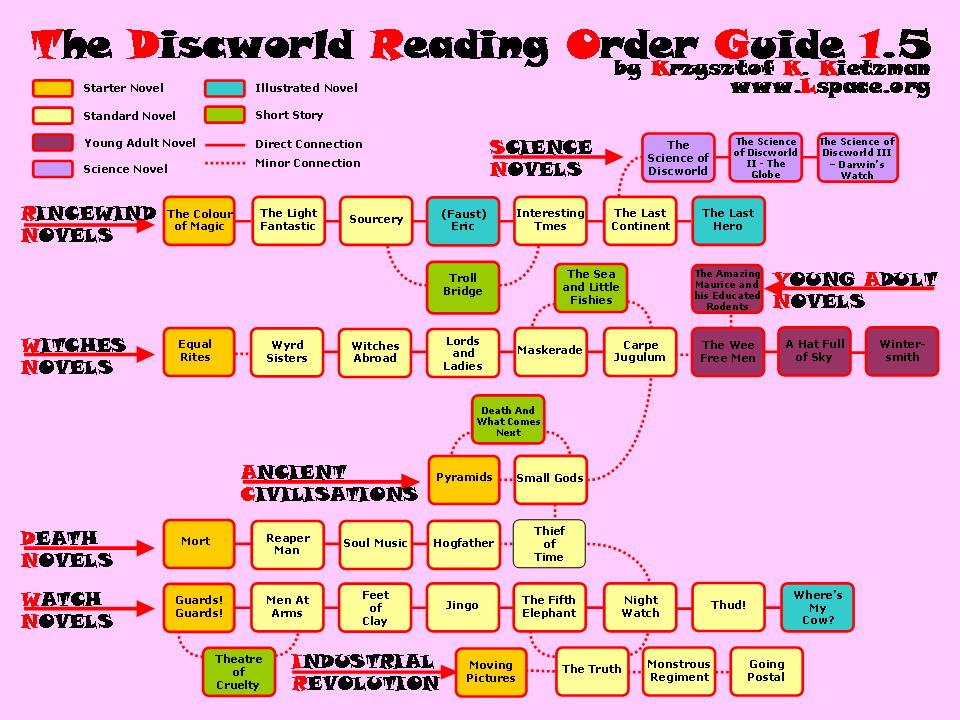
As I mentioned previously, I discovered Terry Pratchett while in England, and have read a few of his books since. There's no need to read them in the order in which they are written or which they occur, so I used to just pick up a book I like and that was that. Now I have decided to read the story lines in the order in which I found them here. The L-Space Web is a great resource for Pratchett, with annotations and links to other great web places at which a great amount of time can be wasted. 

The book directly follows the events of The Colo(u)r of Magic, in which the reader left the wizard Rincewind hanging off the edge of Discworld, which is carried on the back of four elephants, which in turn are carried on the back of the giant tortoise Great A'Tuin. Rincewind's great skill is not at wizardry but at staying alive. He meets back up with Twoflower the Tourist and The Luggage, which is still eating some people and staring down others. 

This time, Rincewind's goal (instead of just merely staying alive) is to save the Discworld from the end of time. Unless all eight spells (one of which resides in Rincewind's  head) are read from the great book the Octavo, the Discworld will be no more. The problem? The spell in Rincewind's head. The spell does not wish to be read, yet one wizard back at Unseen University wishes to get his hands on Rincewind. 

Rincewind encounters even more interesting characters in this book, notably Cohen the Barbarian and Bethan, the virginal sacrifice. The reader also gets a glimpse into the Realm of Death, which is surprisingly full of flowers and a quaint cottage. There is also a bit of time spent in a magical store, which can never be found in the same storefront twice. 

Another whimsical book that I couldn't put down. Pratchett's book is smart and humorous, and finding the rest of his books will be great fun! 

Friday, March 27, 2009

The Color of Magic by Terry Pratchett

I first found out about Pratchett and his Discworld novels during my exchange trip to England in college. I was out of reading material and a friend of mine gave me one of his books to read. Eight years later and I'm still reading his books! 

The first book in the Discworld series, The Color of Magic introduces us to the very colorful creation of Pratchett's mind. Discworld is carried on the backs of four giant elephants, which in turn are carried by Great A'Tuin the turtle. The gender of Great A'Tuin is in question, and the main objective of Krull through the years was to discover if Great A'Tuin was male or female. 

Then there is Ankh-Morpork, in which we find the wizard Rincewind, though to call him a wizard is a great exaggeration. He finds himself pressed into service by acting as a tour guide for Twoflower, the tourist. Through the book, the hapless wizard is led on more adventure than he had ever wished to encounter. 

The book is great set-up for the series, as Twoflower and Rincewind find themselves traveling across the Discworld in search of adventure (or in Rincewind's case, avoiding it). The book is not a quick read, but needs to be savored, as Pratchett uses humor and satire to paint his world. He throws a lot of fairy tale and fantasy plot devices into the book, though by no means does he limit himself. The city of Ankh-Morpork, for example, is based off the city of Budapest in that it was once two cities separated by a river. The Patrician of the city is very Machiavellian in his methods.  There is also Hrun the Barbarian, who is the epitome of every hero in any story--from his long, flowing locks to his single-mindedness in finding damsels and treasure. 

The cover of the book is my biggest issue, as it is very boring. Pratchett's books are full, and the American covers fail to fulfill that. The British covers, on the other hand, are very busy. 
With the British covers, I frequently find myself trying to figure out who are what characters and what is going on! They're not known for their attractive qualities, and they don't look contemporary, but rather something I would pick up at a yard sale or flea market. With the smell of decaying paper. 

Regardless, there must still be some kind of happy medium between the two covers. The American cover fails to deliver for the goods inside, while the British cover delivers the goods too well. 


Lastly, I found out today that there is a movie for The Color of Magic. Granted, it was a television movie and only seen in the United Kingdom, but I am still curious enough to wish to see it. At first I thought it might be an animated movie, but no, it is quite live action. It stars Sean Astin as Twoflower and Jeremy Irons as the Patrician. (That last bit is enough for me to want to see it. 
Granted, they are going to take some liberties with the story. The movie includes the character "Cohen the Barbarian" (see his play on things?) while the book had "Hrun the Barbarian." It also includes characters that will show up in later books in the Discworld series. Some research shows that the movie is based on The Color of Magic as well as the next book, The Light Fantastic.

In a perfect world, the Discworld series would continue. Alas, Pratchett was diagnosed with early-onset Alzheimer's, which means the end of Discworld will come sooner than we all could wish for. 

Friday, March 13, 2009

Water for Elephants by Sara Gruen


It's not very often that I find myself crying because of a book. Usually if I do, it's because I either get a paper cut or the book is so horrible that it makes me miserable. 

Not so with this book. 

The story starts with a stampede and a murder at the Benzini Brothers Most Spectacular Show on Earth. Jacob Jankowski, Cornell-educated veterinarian, is witness. In the book, he tells the story of how he ran away from his life and joined the circus. What starts as a cliche turns into a touching story of a man who comes of age during the Great Depression and navigates the treacherous waters of a traveling circus. Gruen's characters are vividly painted, from the blustery ring top leader (who is not a Benzini Brother), to the star of the equestrian act, and to the "great gray hope" of the show, elephant Rosie. 

Gruen's inspiration to write about a Depression-era circus came from an article she read in the Chicago Tribune about circus photographer Edward Kelty. She writes about the circus in times before political correctness spelled the end of the "freak show" (the Lovely Lucinda was Uncle Al's underweight fat lady--she was no 850 lbs) and the pressures from PETA. Gruen also highlighted the behind-the-scenes back-stabbing as well as the competition among the various circus outfits. A bonus were the added circus photographs from the great depression, which added realism to a wonderful story. 

I would definitely recommend this novel. It's a modern historical fiction with elements of mystery and a twist on a murder.

Devil's Cub by Georgette Heyer

I just finished reading Devil's Cub, the sequel of These Old Shades. It is the story of Justin and Leonie's son, Dominic, the Marquis Vidal. The story opens when Vidal shoots a highwayman on the way to a party. This sets the character of Vidal very well, as he is very debonair, sophisticated, and can do no wrong. Every man wishes to be him, and every woman wants him.

He, however, does not want any woman. His eyes are on the lovely Sophia Challoner, but not as his wife. Instead he wishes to whisk her off to France and give her carte-blanche. In an effort to stop her sister from ruining her reputation--for Sophia thinks the Marquis means marriage--Mary Challoner takes her place. Alas, by the time Dominic finds out the switch, he is so angered that he takes Mary in her sister's place.

On their journey through Paris, Dominic discovers that Mary is nothing at all like Sophia and he has made a huge mistake. He immediately offers marriage, but Mary declines, preferring the life of a governess to that as his wife. After a sojourn in Paris, an escape attempt, and the arrival of the Duke of Avon on the scene (which Vidal was hoping to avoid at all costs), the story is in full swing.

It's a great story and I would definitely recommend her books. Right now I am tired of more recently published romance novels, especially the ones that descend quickly into the sex scenes and the love between the characters is not quite believable. I enjoy picking up a Heyer because it's a deeper read and so enjoyable. She is one author that a glom will not ruin!

Tuesday, February 10, 2009

Dogs and Goddesses by Crusie, Stuart, and Rich

I have very few authors that I auto-buy for anymore. When I first started reading romance, there would be almost two releases a month that I would have to buy. Not so much any more. Along with Susan Elizabeth Phillips I auto-buy Jennifer Crusie's books, even her collaborations with other authors. This one includes Anne Stuart and Lani Diane Rich. 

The collaboration is a tricky thing. With three authors on the cover, the tendency to think the book is an analogy is pretty high. This book is a novel, with all three parts nearly seamlessly working together. The authors have been very open about the process on their blog, Dogs and Goddesses.  The other type of collaboration, which this is not, is the one where a well-known author puts his/her name on a book with a less well-known author to help that author get a following. This is similar to the process used by the anthology, which one or two well-known authors are tied with one or two other authors that are less well-known. 

If a collaboration must be done, I prefer the novel over the anthology. Anthologies usually have stories that would be more interesting if fleshed out into a full book, or the stories are so dull that they're not worth reading. 

Dogs and Goddesses follows three women in a small Ohio town who are drawn to a dog training class. While there, they meet the enigmatic trainer, Kammani, who hands them a tonic to drink. In a short period of time, the three women not only meet the men of their dreams, but they hear voices and swear their dogs are talking to them. Before long, they're all trying to defeat an ancient Mesopotamian goddess that's trying to regain her rightful place in the world.  

I'm no expert on anything Mesopotamian, so that helped me to suspend my disbelief well enough, and the authors' note at the beginning about how it is all made up made me feel even better. I did find the myth a little confusing and kept having to go back to parts that I re-read already in order to solidify it. Of course, after having read it, I found the entire myth on the webpage. 

This is one of my pet-peeves: if there's a mythology created for the book, the reader shouldn't have to rely on outside sources to discover it. This isn't a series, and that's a completely different kettle of fish. I shouldn't have to do research to enjoy a novel. I didn't read the blog as it was being created, and I don't feel that should be necessary in order to join a book. It feels much too clique-ish. 

Based on that, I give the book a solid B. I liked the story, and it's good for a collaboration. 

Sunday, February 01, 2009

What I Did for Love by Susan Elizabeth Phillips

I rarely buy hardcovers. If they're on the bargain table and cheaper than the paperback, I buy it. If it's a book on history and I can't wait to get it, I buy it. If it's by Susan Elizabeth Phillips, I buy it. I tried to wait for Match Me If You Can a few years back and almost couldn't do it. So, I've bought the last two of her books in hardcover, and almost wish I had waited. 

Former child star Georgie York has been dumped by her actor husband for a humanitarian actress. She and her detestable former co-star, Bram Shepard, end up running into each other in Vegas, and the inevitable happens--they run to an all-night chapel and end up married. Each of them have different reasons for wanting to stay in the marriage of appearances, but what will it turn into? 

Like all of Phillips books, the two main characters go through a transformation. They are not the same people they were at the beginning of the story. Georgie is fragile after her break-up, and the constant attention by the paps doesn't help matters. She's trying to figure out the next stage in her career and up against her stage-father who insists on running her career. Bram probably goes through the least transformation, as he gives the appearance of being dissolute at the beginning of the book, though the reader is quick to realize that Bram has grown a lot since his partying days on the set of their sitcom.  

There is also a secondary romance with Georgie's father, Paul. His story to me was more interesting, as he put his dreams on the back burner for the sake of his daughter. The relationship with his daughter also undergoes a radical transformation. 

The weakest part of the story was the setting. I'm not a Hollywood person--I find the E! network horrible, and I feel icky every time I find myself watching it. The inspiration for the story was also very obvious--the parallels between the Jennifer Aniston  and Jolie-Pitt affair slap the reader in the face. Are there differences? Sure, but Phillips makes the Jolie-Pitt characters in the book very flat. There's nothing at all to like about them, even though they're not really villains. 

The traditional Phillips hallmarks are present, but it's not my favorite venture by her. I'll return to her backlist. 

B-

Saturday, January 31, 2009

All Together Dead by Charlaine Harris

I've lost count as to how many Sookie Stackhouse books I've read. I'm thinking that this may be book number 7! 

All Together Dead picks up in the aftermath of the trip Sookie took to New Orleans, where she met the vampire Queen of Louisiana and witnessed the death of the vampire King of Arkansas. She is now fully embroiled in the world of the supernatural: vampires, werewolves, fairies, and demons, to name a few. Now she has returned to Bon Temps. Hurricane Katrina has forced the vampires of New Orleans to relocate, including the Queen. Sookie is also still estranged from her ex-boyfriend Bill. 

The main action of the novel takes place in the city of Rhodes, where Sookie is going to a vampire convention. While there she meets up with Barry Bellboy, another telepath that she met in Dallas. He works for the King of Texas in the same capacity Sookie works for the Queen of Louisiana: they ferret out information from the other humans who work for the other kings and queens. The main event of the convention is the  trial of the Queen of Louisiana for the death of her husband. While the vampire convention seems to be going smooth at a vampire hotel, the Fellowship of the Sun has been protesting the entire event. 

The usual cast of characters shows up in this book, including Eric and Quinn the were-tiger. Harris is really ratcheting up the tension in this book and hinting at future problems between vampires and humans. Harris created a believable world, using reality as her backdrop for the supernatural.  Her voice is consistent throughout the series, yet she manages to show a growth in the character of Sookie, who has grown more world-weary and sarcastic. I'm not sure how much I like this new Sookie, but it's understandable. 

B+

Saturday, January 03, 2009

Never Romance a Rake by Liz Carlyle

Never Romance a Rake is the third book in a trilogy about the siblings of Neville shipping. The first book was about Miss Xanthia Neville, the second was about their family friend Gareth Lloyd, and this book is about Kieren, Baron Rothewell. 

Rothewell is a dissolute drunkard whose past, like many romance heros, haunts him. He attempts to escape it by playing cards and drinking himself into an oblivion, but this plan backfires on him by ruining his health. One night he is playing cards when the pot is sweetened with Comte Valigny's daughter, Camille. He wishes to get his ungrateful daughter off his hands, and she wishes to be away from her father. Her pickings are slim, and in a rare burst of compassion, Kieren cheats because her other option that night is even worse than him. 

Camille's background is equally sordid to that of Kieren. Her mother had been married to an English lord, but she ran off with the comte early into her marriage. The husband divorced her mother, which was scandalous, and Valigny never married her mother thanks to some Church rule about divorced people marrying.  After her mother's death, Camille found that her maternal grandfather left her a large bequest, and she pushed Valigny to find her a husband. 

Neither Kieren nor Camille want anything more than a business-like marriage. As time passes, though, this becomes impossible. This is one of Carlyle's books that doesn't have a mystery behind it--it is more character-driven than plot-driven. The questions brought up in this book are about Camille's parentage and Kieren's health. 

Carlyle is very good at writing tortured, yet realistic, characters. They have good reasons for being the way they are from their pasts, and this goes beyond a mere "I was a spy for the English government during the Napoleonic Wars" spiel that so many books have. That or the "My mother died when I was young" or "My daddy didn't love me" chestnuts that are thrown about. No, Carlyle's characters have been through a lot. And I respect her in that not all of her nobles are earls or dukes. She uses those titles, but lesser noblemen are acceptable as well. 

A. 

Tuesday, December 16, 2008

The Seduction of the Crimson Rose by Lauren Willig

The Seduction of the Crimson Rose is the fourth book in Lauren Willig's Pink Carnation Series. A very popular genre within the last decade is the Napoleonic era (if you are in France) and the Regency era (if you are in England). Spying is the favored profession among England's noble elite, and if one is a nobleman, you are expected to serve your country. 

Indeed. 

So much so is this particular time period popular that a lot of books run together in plot. Willig's books differ in that they fit into historical fiction more than historical romance. They have a slight flavor of a regency romance over a true romance novel. 

In The Crimson Rose, Mary Alsworthy is approached by Lord Vaughn to work for the Pink Carnation. In return for being bait to lure the Black Tulip (the Carnation's archnemesis) out into the open, all Mary wants is for Vaughn to fund the next Season for her. Why? Pride. Mary's younger (and homelier) sister recently wed Mary's former suitor, and the brother-in-law has offered to fund the next Season. Mary, however, doesn't wish to be seen as an object of pity, so she'd like her Season to be funded in another way. 

Lord Vaughn has good reason for picking Mary: her black hair is one hallmark of agents that work for the Tulip. Mary is also a good screen for Vaughn, who has been suspected by many, including those in the Pink Carnation's circle, of being the Black Tulip. 

Of all the couples in the books, I like Mary and Vaughn the best. They are not perfect. Mary can be cold and manipulative, well aware of the fact that as a woman, her status depends on making a good marriage. She wants to be comfortable, and she realizes that comfort and love are not the same thing. Vaughn is also sarcastic and has a dry wit; the two often trade barbs. Vaughn also has the requisite black past, complete with dead wife, dead mistresses, and membership in various and sundry hellish clubs. His reputation is hardly pristine, and he is well aware of it. 

Many of my comments on this book are the same as the other books. The book is a light read and doesn't fit cleanly into one genre. It's a combination of chick lit and historical fiction, with a dash of mystery. It's very light on history, with not a lot of substance, mostly the outer trappings. It should not be read to get a deeper understanding of the time period. 

I'm not sure where Willig is going with the series. We know who the Pink Carnation is. Her historian, Eloise, knows who the Pink Carnation is, and she's well on the way to a Happily Ever After herself. Willig introduced an element of the Jacobite Rebellion, when Bonnie Prince Charlie attempted to take his "rightful" place on the throne of England. 

Since I liked the main characters, which is what really counts, I give the book an A. 

Sunday, November 30, 2008

Constantine, Christianity, and "That Dude's Movie Code"

I've been reading Mysteries of the Middle Ages And the Beginning of the Modern World by Thomas Cahill. I picked it up because I very much enjoyed his book How the Irish Saved Civilization. I picked this book up because I've frequently thought of the Middle Ages as a backward era lacking in education and intelligence. Despite the legends of knights and castles, it's not one of my favorite time periods to read about or to teach. 

My students, however, disagree. They love it. This is the one time period where they are enraptured by everything. So, I try to oblige. Hopefully this book will help open my eyes to some of the more interesting topics that I've skipped in my dislike. 

So far I've found the book interesting, though I still have not progressed past the Roman Empire. Official tolerance of Christianity was brought by the emperor Constantine. I did read an interesting footnote that I couldn't pass up without a mention: 
The depiction of Christianity in the popular thriller The Da Vinci Code as a fraud perpetrated by Constantine not only is preposterous to any reader with a modicum of historical knowledge but rests on melodramatically anti-Christian assumptions. The book's further premise that the Catholic Church sends out Opus Dei hit men to murder anyone who has stumbled on the truth is a straight-forward anti-Catholic libel. And its notion that Jesus fathered progeny by Mary Magdalene is a fantasy lacking the least historical support.

Wow, Mr. Cahill! Showing our bias, are we? Not that I disagree with him, but I haven't come across such vehement rhetoric in a history book before. Someone didn't like Dan Brown's bestseller, which I find refreshing. I haven't read it myself, but I've had enough of people insisting that it's real, with one acquaintance swearing that it opened their eyes to the truth behind the Catholic Church. 

Like I didn't have enough questions to answer about my faith in Baptist Land, Dan Brown had to go and open up the floodgates. That and the questions during my Renaissance unit if that's Mary Magdalene in the painting by "that dude with the movie code." This has made any urgency I felt to read the blasted thing go out the window. 

I did, however, watch the National Geographic special. I am so glad that I kept my subscription.